A Yellowstone Angler guide to DePuy Spring Creek suggests booking late June and mid-July dates several years ahead. A rod on those summer days costs $150. Today the same creek charges $50 a rod, and that rate holds every day from October 15 through April 14.
DePuy, Armstrong and Nelson's are the three private spring creeks of Paradise Valley, all with Livingston addresses. Each has a winter rate and its own winter rules. The water stays fishable after the freestone rivers have stalled. If you live in Livingston or anywhere along US-89, the cheapest and least crowded months to fish these creeks are the ones starting now.
Why the creeks keep fishing after the river stops
The Yellowstone in January is a different river from the one floated in July. Dan Bailey's Fly Shop described that winter river in its February 11, 2025 Livingston-area fishing report: shore ice limiting access, boat ramps frozen in, cold freestone water. The shop said fishing it means finding safe access out of the wind, watching for midges at midday and nymphing deep and slow. The same report called the spring creeks the more consistent winter option.
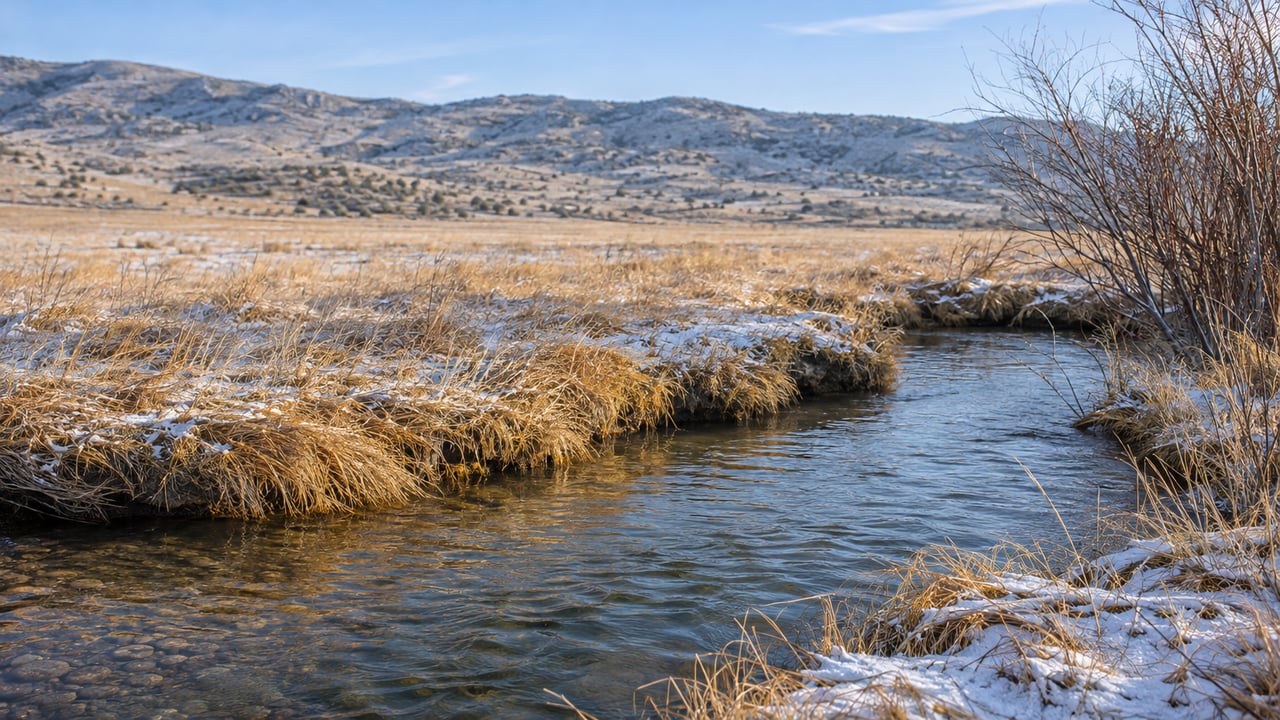
The difference comes from where the water starts. A spring creek rises from groundwater, so its temperature barely moves with the seasons. Yellowstone Angler lists both DePuy and Armstrong at 48 to 54 degrees all year. Nelson's describes steady flow and temperature, and a creek that does not ice up in winter.
Water that warm keeps insects hatching. DePuy's hatch page says midges come off for most of the year, and that winter and the gaps between big hatches tend to favor nymphing. Yellowstone Angler names midges as the main winter food on Armstrong and mentions dry-fly fishing on calm days. In a winter fly guide, Sweetwater Fly Shop adds late-fall and winter Baetis hatches and points to chironomid larvae and pupae as the important food below the surface. The same guide notes the lower fees and lighter pressure of the off-season.
What the winter rates look like next to July
All three creeks are on winter pricing by the time you read this. Nelson's is the last to switch: its winter season runs November 1 through March 31. Here are the posted rates for each creek's winter window and its peak window:
| Creek | Winter rod fee | Winter dates | Peak rod fee | Peak dates |
|---|---|---|---|---|
| DePuy Spring Creek | $50 | Oct 15 – Apr 14 | $150 | June 15 – July 31 |
| Armstrong Spring Creek | $50 | Oct 15 – Apr 14 | $150 | June 15 – July 31 |
| Nelson's Spring Creek | $60 | Nov 1 – Mar 31 | $140 | June 15 – July 31 |
That puts a winter day on DePuy or Armstrong at one third of a midsummer day. Nelson's winter fee is a little under half of its high-season rate. The shoulder seasons fall in between. DePuy and Armstrong both charge $100 from mid-April to mid-June and again from mid-September to mid-October, and $120 from August 1 to September 14.
DePuy also sells a $500 winter pass for the same October 15 to April 14 window, in limited numbers. At the $50 daily rate, the pass costs the same as ten days on the creek. Every day after the tenth costs nothing extra, so the pass suits someone who lives close enough to fish a few hours on a weekday.
These are the rates as each creek posts them. Confirm the current figure when you call.
Nelson's is open to everyone on weekdays only in winter
Nelson's Spring Creek sells six rods a day and is closed on Sundays. From April through October, weekday rods go to guests of Nelson's Spring Creek Lodge. Anglers who aren't staying at the lodge can book Saturdays, or take whatever weekday rods are still open within four weeks of the date. The lodge's cabins are open April 1 through October 15. In winter the lodge is closed, and the booking page says any angler is welcome to fish Monday through Saturday.
For someone in Livingston, that turns a creek you could mostly reach on Saturdays into one you can book on a Tuesday. With only six rods a day, it is also among the quietest private water in the valley. Nelson's covers three-quarters of a mile. Guides are available through a partner outfitter, and the fishing page doesn't say you have to hire one.
The one catch is that winter booking happens by phone. Nelson's says its online booking engine doesn't work during the winter months, so call 406-220-6560. The creek is at 101 Nelson's Spring Creek Road in Livingston.
DePuy has the most room and a warm place to stop
DePuy has the most capacity of the three. It allows 16 rods a day. Normal check-in runs from 7:30 to 10:30 a.m., other times are by appointment, and you can fish as late as you like. Yellowstone Angler puts the DePuy portion of the creek at about 2.8 miles and says all of its fish are wild. To get there, take US Highway 89 South five miles from I-90 exit 333 to mile marker 48.
For winter fishing, the most useful thing at DePuy is the warming hut. Yellowstone Angler describes it as stocked with wood in winter, with tables and a stove. The creek asks for barbless hooks and careful handling of spawning fish.
Reservations go through Daryl or Theresa at 406-222-0221, or by email through the creek's rates page. DePuy's terms are the strictest of the three. It takes a 50 percent deposit on every reservation and requires 60 days' notice to cancel, or you forfeit the deposit. If the forecast is unsettled, the winter pass avoids that problem.
Armstrong is the creek on a working ranch
Armstrong Spring Creek flows through the O'Hair Ranch at 112 O'Hair Lane, about eight miles south of Livingston off US 89 South. The ranch runs it as a catch-and-release fishery. The ranch also has lodging, through O'Hair Lodge, with the creek running through the property.
Book by calling (406) 222-2979. The ranch asks anglers to book as early as they can, especially for June through September. In winter, at the same $50 rate DePuy charges, early booking matters much less.
Planning a winter day on the creeks
DePuy and Armstrong are both reached from US 89 South, so the drive is part of the plan in January. Our earlier post on winter driving on US-89 in Paradise Valley covers that road. This fall's post on Auster and the Dome Mountain miles covers the elk crossings farther south.
Winter midges come off around midday, according to Dan Bailey's report on the river, and DePuy's check-in window ends at 10:30 a.m. A mid-morning arrival puts you on the water for the warmest hours with time left in the afternoon.
Each creek makes sense for a different kind of day. Nelson's has six rods and open weekdays, so it suits a quiet day when you want to be close to alone. DePuy has 16 rods and the warming hut, and it suits a friend visiting for the holidays or a series of short weekday trips on the pass. Armstrong has DePuy's winter price, about eight miles south of Livingston. Our Paradise Valley neighborhood page and the post on life along the Yellowstone cover more of the valley around these creeks.
Spring creek water and the land around it are a big part of why people settle in Paradise Valley, and they shape what that land is worth. If you're weighing a property near East River Road or US-89, or thinking about what your own Paradise Valley land could become, Mark Meissner brings development experience and a local's knowledge of the valley to that conversation. Start the conversation.